Listen to the audio about the Piazza del Plebiscito and answer the questions.
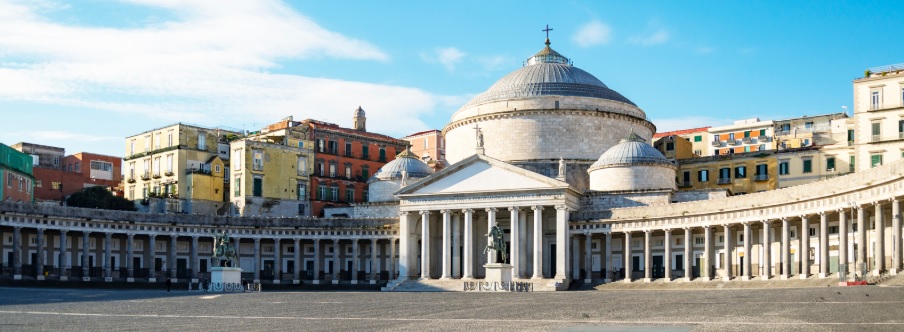
Piazza del Plebiscito is the largest and most majestic square in Naples, serving as the symbolic heart of the city.It is famous for its grand semicircular colonnade and the Royal Palace, a site that attracts thousands of visitors from around the world.
Located at the end of the busy Via Toledo, the Piazza sits between the historic center and the sea, close to the San Carlo Theater and the Galleria Umberto I. The current layout was largely designed during the Napoleonic era under Joachim Murat. Before this transformation, the area was mostly a large open space used for popular festivals and tournaments. During the 19th century, the square was dedicated to the "plebiscite" that brought Naples into the unified Kingdom of Italy.
At the beginning of the 19th century, the original buildings were demolished to make way for a grand architectural project, but the ancient spirit of the city was preserved through the surrounding monuments. The focal point is the Basilica of San Francesco di Paola, which features a 53-meter-high dome and was built to resemble the Pantheon in Rome.
Construction of the Basilica began in 1816, commissioned by King Ferdinand I of the Two Sicilies to celebrate the restoration of the Bourbon monarchy. The chosen architect, Pietro Bianchi, worked on the project for several years until its completion in 1846. Two equestrian statues—representing Charles III and Ferdinand I—were placed in the center of the square, standing as silent guardians of the city's royal past.
By the end of the 20th century, the square needed to be renovated to reclaim its beauty, as it had been used as a parking lot for several decades. In 1994, the area was finally closed to traffic, transforming it into a pedestrian-only masterpiece. This change allowed the square to become a venue for major concerts and art installations, and since then, Piazza del Plebiscito has been the primary gathering point for Neapolitans during important celebrations.