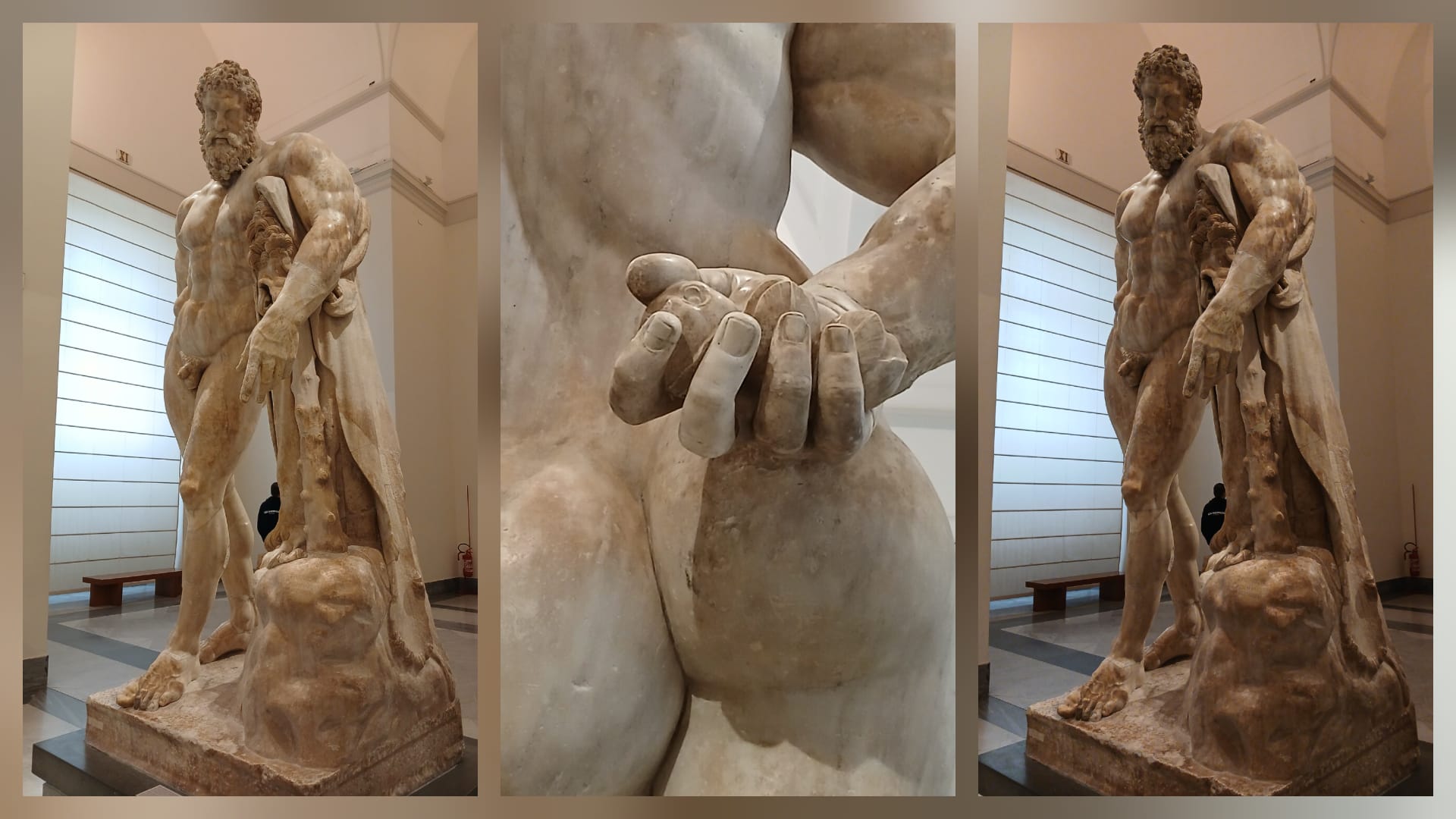
The Farnese Hercules is undoubtedly one of the most celebrated masterpieces of the Farnese collection housed in the National Archaeological Museum of Naples (MANN). This colossal marble statue, JXUwMDNiJXUwMDAyJXUwMDEzJXUwMDA0JXUwMDEzJXUwMDAx
in the 3rd century AD, is a faithful copy of a lost Greek bronze original from the 4th century BC, attributed to the legendary sculptor Lysippos. We are fortunate to know the creator of this specific marble rendition: the Athenian sculptor Glykon, who boldly signed his name on the stone positioned in front of the JXUwMDM1JXUwMDA0JXUwMDBlJXUwMDBmJXUwMDFjJXUwMDBk
demigod.
Iconography and the Last Labour
The statue follows a traditional iconographic repertoire, JXUwMDNjJXUwMDAxJXUwMDE1JXUwMDE5JXUwMDBhJXUwMDE3JXUwMDFkJXUwMDA3JXUwMDA5
Hercules resting upon his famous club, which is draped with the skin of the Nemean Lion. While these symbols are easily visible, the sculpture hides a crucial detail: JXUwMDNhJXUwMDA3JXUwMDBkJXUwMDAxJXUwMDA3JXUwMDBh
his back, Hercules’ right hand secretly clutches the Golden Apples of the Hesperides. This suggests he has just completed his final, grueling JXUwMDM0JXUwMDBkJXUwMDAzJXUwMDBkJXUwMDFhJXUwMDA3
, capturing him in a rare moment of reflection immediately following his JXUwMDJjJXUwMDA2JXUwMDFiJXUwMDFjJXUwMDE4JXUwMDFkJXUwMDE4
.
Discovery and the "Battle of the Calves"
The statue was unearthed around 1500 in the Baths of Caracalla in Rome, alongside a "twin" known as the Latin Hercules (now located at the Royal Palace of Caserta). When it was found, the Farnese Hercules was missing its calves. Giacomo Della Porta, a talented JXUwMDI4JXUwMDA1JXUwMDA1JXUwMDE5JXUwMDA1
of Michelangelo, was commissioned to sculpt replacements. Interestingly, when the original ancient calves were eventually discovered, they were not immediately reattached. Experts at the time believed Della Porta’s work was of superior craftsmanship. It wasn't until the 18th century, under the Bourbon dynasty, that the original ancient legs were JXUwMDNlJXUwMDBmJXUwMDA3JXUwMDBmJXUwMDBkJXUwMDAwJXUwMDE1
restored. Today, Della Porta’s "discarded" calves are still on display directly behind the colossal statue as a testament to this art historical debate.
Artistic Legacy and Modern Inspiration
Historically, both the Farnese and Latin Hercules stood together under the arches of the Villa Farnese in Rome (now the French Embassy). Michelangelo’s JXUwMDNkJXUwMDBiJXUwMDA5JXUwMDE1JXUwMDEzJXUwMDE3JXUwMDFmJXUwMDA3JXUwMDA5JXUw
MDE0
of this original setting served as the inspiration for a 2021 installation by the street artist JR. He created a majestic, illusory "gash" on the facade of the French Embassy, using JXUwMDI4JXUwMDE1JXUwMDE3JXUwMDAxJXUwMDAzJXUwMDE1JXUwMDA2JXUwMDE3JXUwMDFkJXUw
MDFmJXUwMDEz
to simulate the interior rooms where the Hercules could be seen resting on his club.
The Lysippean Revolution: A Human Demigod
What JXUwMDJjJXUwMDA2JXUwMDA3JXUwMDE5JXUwMDE1
sets this statue apart is its psychological dimension. Traditionally, Hercules is portrayed in the heat of JXUwMDNhJXUwMDAzJXUwMDE1JXUwMDAwJXUwMDE4JXUwMDA5
with contracted muscles—much like Canova’s later version in Rome’s National Gallery of Modern Art, which captures the moment of maximum tension.
Lysippos, however, introduced a revolutionary approach. Instead of a JXUwMDI4JXUwMDAyJXUwMDFkJXUwMDFhJXUwMDEx
, invincible hero, he presents a demigod stripped of his pride, showing his intimate, human exhaustion. His gaze is not fixed on the horizon but directed toward the ground, his forehead furrowed by JXUwMDJmJXUwMDA1JXUwMDFiJXUwMDA3JXUwMDA1JXUwMDA3JXUwMDA5JXUwMDE2
as he remains absorbed in his own thoughts.
Visitors to the MANN can further explore this theme in the Roman Campania section, where another statue of a "Hercules at Rest" is preserved. Comparing the two reveals the deep commonalities in how ancient artists sought to bridge the gap between the divine hero and the weary human.