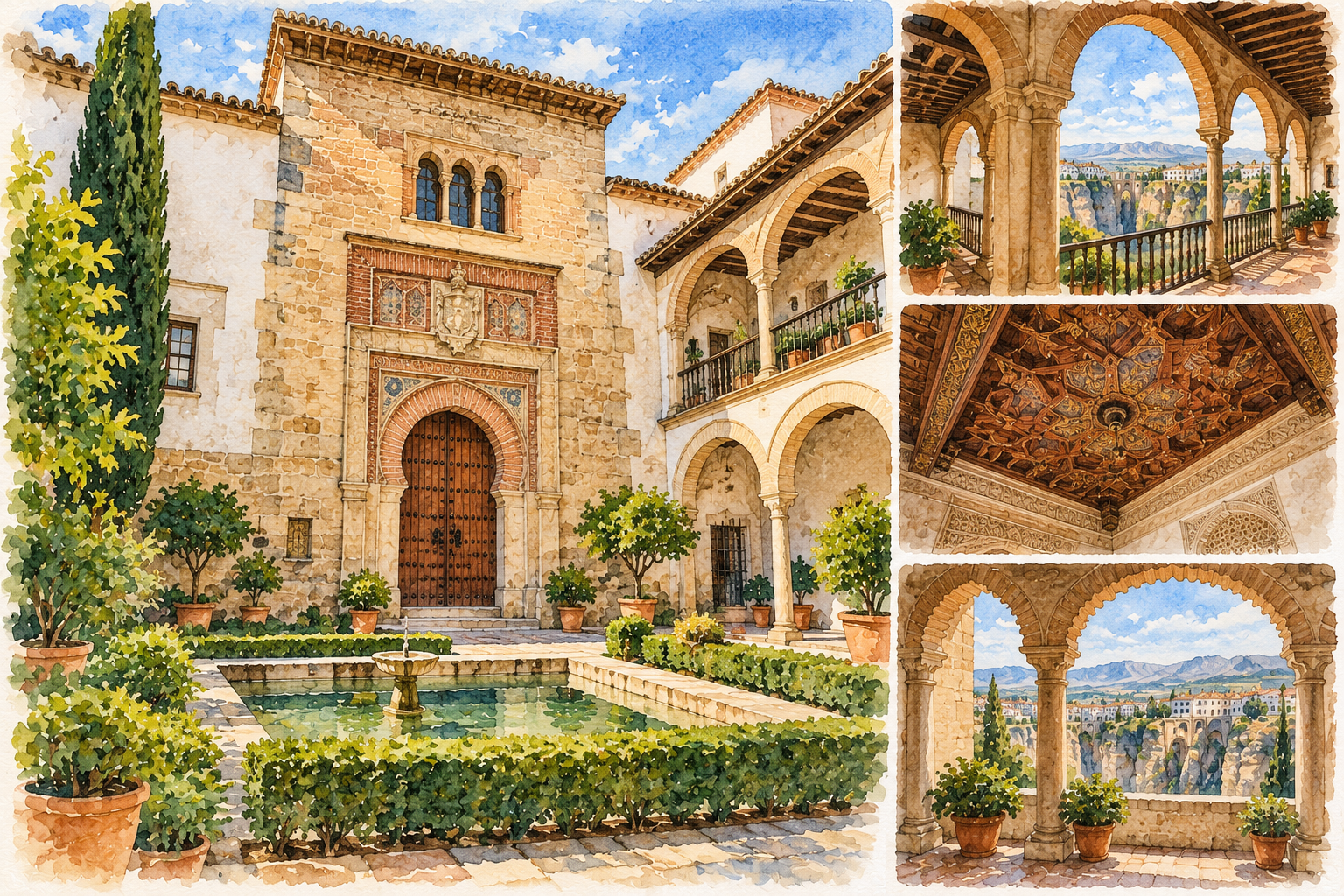
Palacio de Mondragón (Palace of the Marquis of Villa Sierra)
Listen to the audio and answer the questions.
Comprehension Questions
Who was the original founder and resident of the palace in 1314?
What architectural transformation occurred after the Christian conquest of 1485?
Which historical eras are represented in the museum collections housed inside today?
Palacio de Mondragón (Palace of the Marquis of Villa Sierra)
"Our final historical stop in Ronda is the Palacio de Mondragón, also known as the Palace of the Marquis of Villa Sierra. This magnificent complex offers a visual timeline of Ronda's political transformations. Originally constructed in 1314 by the Moorish ruler Abomelik, son of the Sultan of Morocco, it served as the royal residence for Islamic governors of the kingdom.
Following the Christian conquest of Ronda in May 1485, the palace became the official residence of the Catholic Monarchs, King Ferdinand and Queen Isabella, during their visits to western Andalusia. Over subsequent centuries, the building underwent major renovations, blending original Mudejar courtyards with Renaissance brick facades, Baroque portals, and 18th-century wooden ceilings.
Today, the palace houses the Municipal Museum of Ronda. Visitors can explore three historical courtyard gardens: the Patio Mudejar with its exquisite tilework, the Patio de la Mina with access to medieval water shafts, and the Patio de doña Elvira. The museum exhibits cover local human history from Palaeolithic cave art at Cueva de la Pileta to Roman artifacts from the nearby ruins of Acinipo.